AI detectors, and the countermeasures against them
Florida Atlantic University · 2024 – 2025
If a detector can be talked out of its own verdict, how much is the verdict worth?
Read the paper (PDF, 3.5 MB)
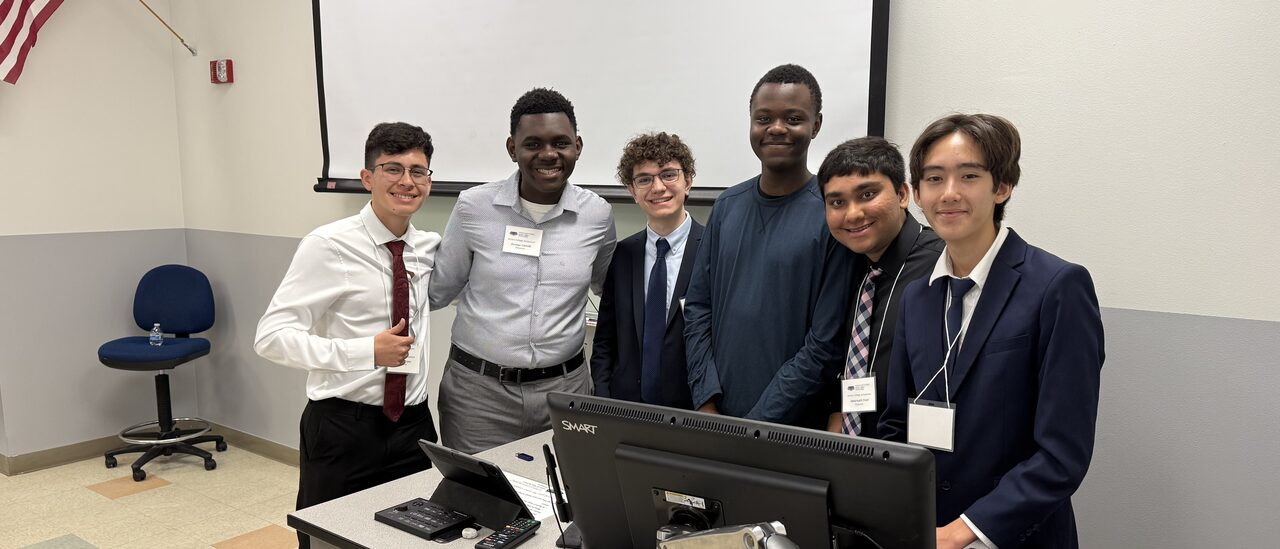 The team at the Wilkes Honors College Undergraduate Research Symposium, March 2025.
Large language models can now produce text that is hard to tell from human writing, which is
what created the market for AI text detectors — and, immediately afterwards, the market for ways
around them. We set out to measure how well the second actually works against the first.
The paper evaluates two evasion techniques. Iterative sampling repeatedly paraphrases a
passage and re-checks it against a detector until it hits a target detectability score.
Coherence and Perplexity Based Optimization (CPBO) builds a branching tree of candidate
continuations and selects among them by weighting toward higher perplexity while pruning for
coherence — perplexity being the signal most detectors lean on.
Method
Human-written corpora came from Kaggle. Three models — Gemini 2.0 Flash, Gemini 1.5 Pro and
GPT-4o — paraphrased that text with no special prompting to produce 35 AI-augmented passages,
each then run through both evasion methods. Every iteration was scored against three detectors
(RoBERTa 105M, ZeroGPT, GPTZero) and evaluated on word frequency, perplexity, coherence following
the entity-based approach of Barzilay and Lapata (2005), and text style transfer measured with
BLEU.
What we found
- Iterative sampling reduces detectability most clearly on older detector architectures,
RoBERTa above all.
- The gains plateau. Almost all the benefit arrives in the first refinement pass rather than
accruing over successive ones.
- GPTZero stayed saturated near a detection score of 1.0 across every iteration and all three
paraphrasing models — R² of 0.004, 0.004 and 0.008. Iterative sampling had essentially no effect
on it.
- Style is the cost. Text style transfer scores decline steadily with each pass, so repeated
paraphrasing buys lower detectability by eroding resemblance to the original writing.
- CPBO results are preliminary, but the branching procedure does reliably surface
higher-perplexity continuations.
We proposed the iterative sampling approach independently in March 2024; in January 2025 we
found that a closely related procedure had since been described by Sadasivan et al. (2025).
Limits
Compute was the binding constraint, and the CPBO conclusions in particular stay tentative
until more data is collected. The findings are specific to the three detectors we tested and may
not carry over to other architectures — watermarking approaches in particular, which embed a
statistical signal at generation time rather than inferring one after the fact.
Credits
Assessing the Efficacy of AI Detectors and Countermeasures in Generative AI —
Jason Makai Pindell, Amarnath Patel, Alexander Castronovo, Jossaya Camille, Zachary Lopez and
Thandi Menelas. Florida Atlantic University High School, the H. L. Wilkes Honors College, and FAU
High School in partnership with the Max Planck Academy for Neuroscience. Supervised by Tucker
Hindle. Grant-funded, with HPC access. Presented at the Wilkes Honors College Undergraduate
Research Symposium, March 2025.