PolyOculus
UCF Astrophotonics Lab · CREOL
Aperture is expensive. The cost of a conventional telescope rises steeply with mirror
diameter, which is what makes very large single-aperture instruments so rare. PolyOculus takes
the other route: link many low-cost, commercially available telescopes together with optical
fibre so the array behaves as one much larger collecting area.
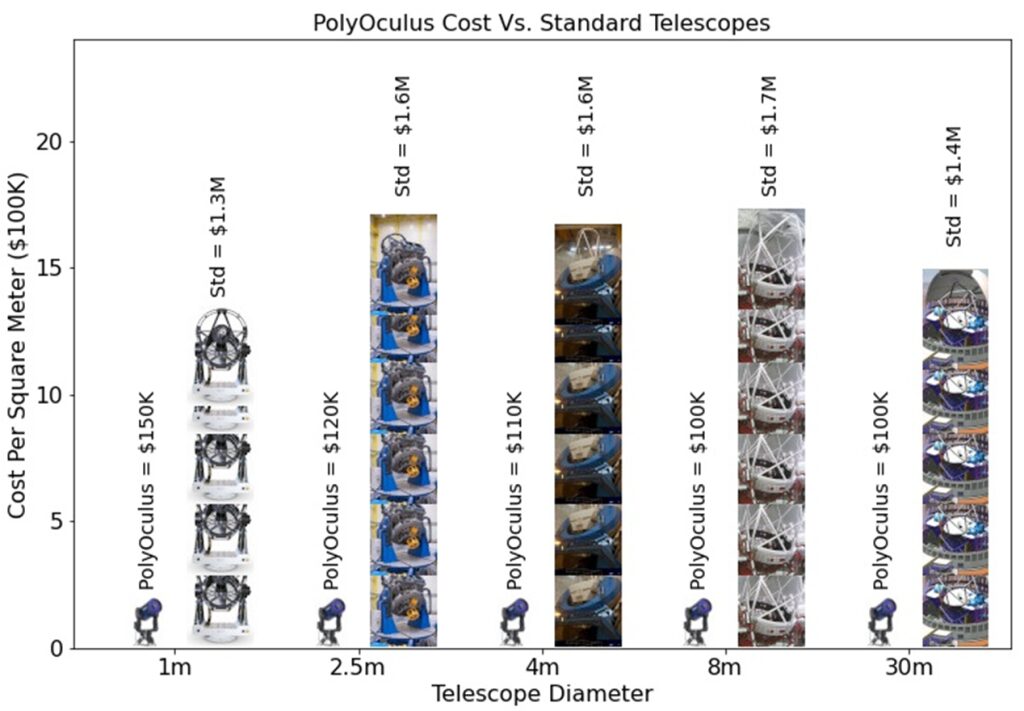 Cost per square metre of collecting area, PolyOculus against conventional telescopes. The advantage widens with aperture. Figure: PolyOculus programme, CREOL.
The science case
The array's driver is a redshift drift experiment — watching absorption features in the
spectra of high-redshift quasars shift over time, a direct measurement of cosmic acceleration
rather than an inferred one. That needs an enormous amount of collected light and an extremely
stable spectrograph, fed through photonic linkage and calibrated against a laser frequency
comb.
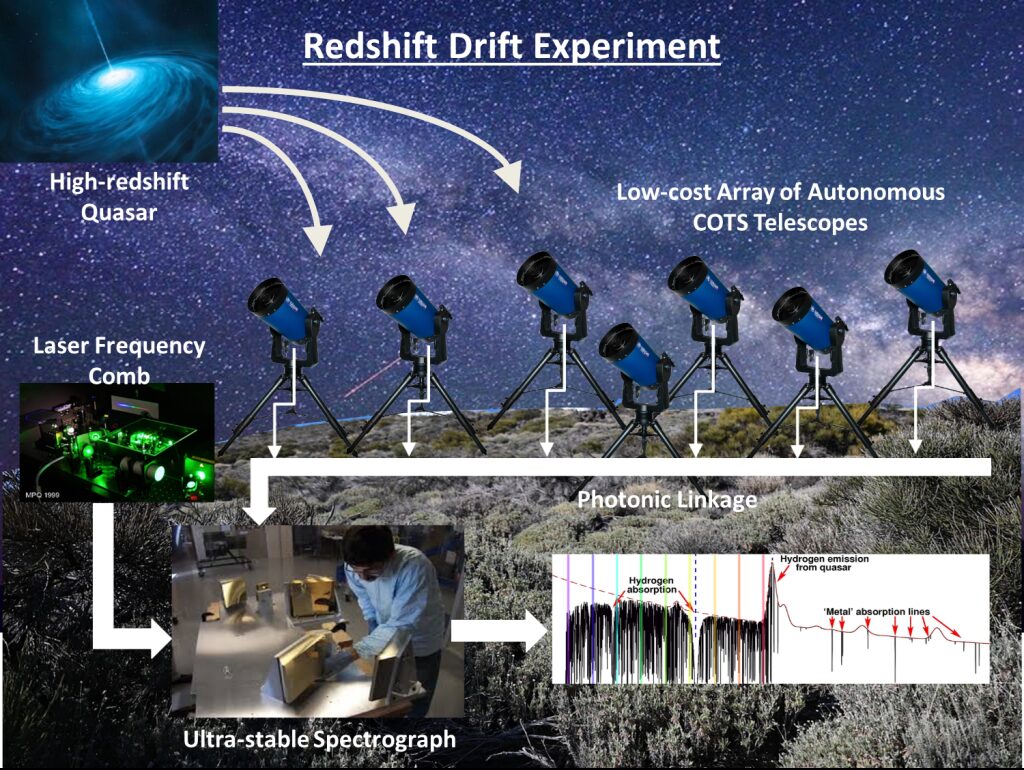 The redshift drift concept — array, photonic linkage, frequency-comb calibration, and the resulting quasar spectrum. Figure: PolyOculus programme, CREOL.
What I work on
I contribute mount control and pointing automation for the array. An array only pays off if
every telescope in it acquires and tracks its target without someone standing at each one, so the
pointing has to be reliable and hands-off across the whole set.
See also photonic lanterns and
CELERIS.